The Auger Trio Presents New Classical Music in Germantown
Student ensemble at Settlement Music School demonstrated the enduring vitality of classical chamber music in a program of mostly new works.
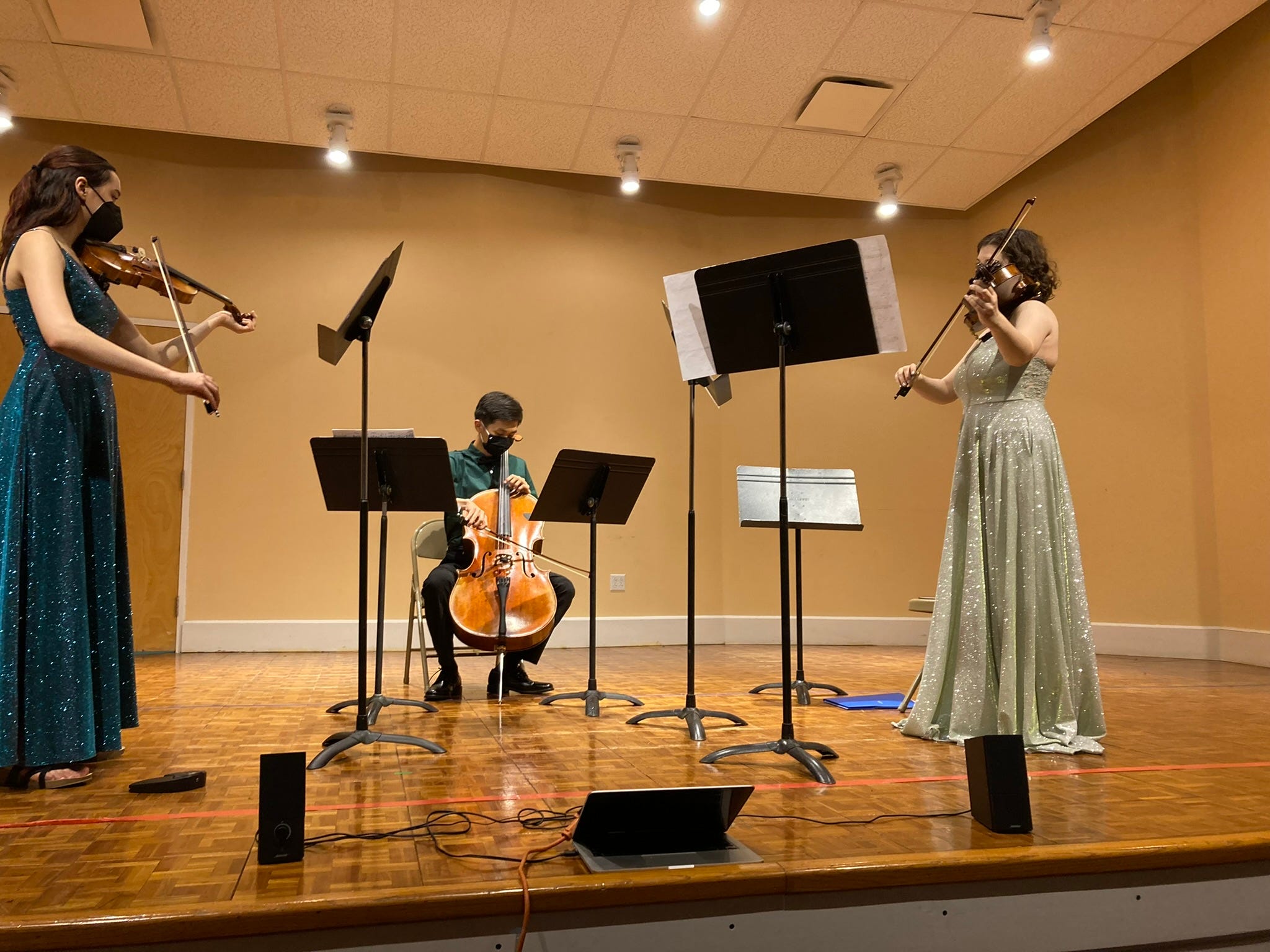
At the Settlement Music School Germantown Branch, the three string players on stage, having finished a last-minute sound check, seemed to be tuning up for the concert that was about to start. The auditorium doors opened, and the audience members entered and found their seats. This turned out to be a sly musical sleight of hand: the players weren’t tuning but had already launched into “In Preparation”—the first movement of Paul Lansky’s 1981 As If for string trio and computer synthesized tape. Lansky begins the piece with what sounds like a tuning session—when does the music actually begin?—and the recorded sound further confounds the listener’s sense of what is the live music and what is pre-recorded.
Advanced Study Opportunities
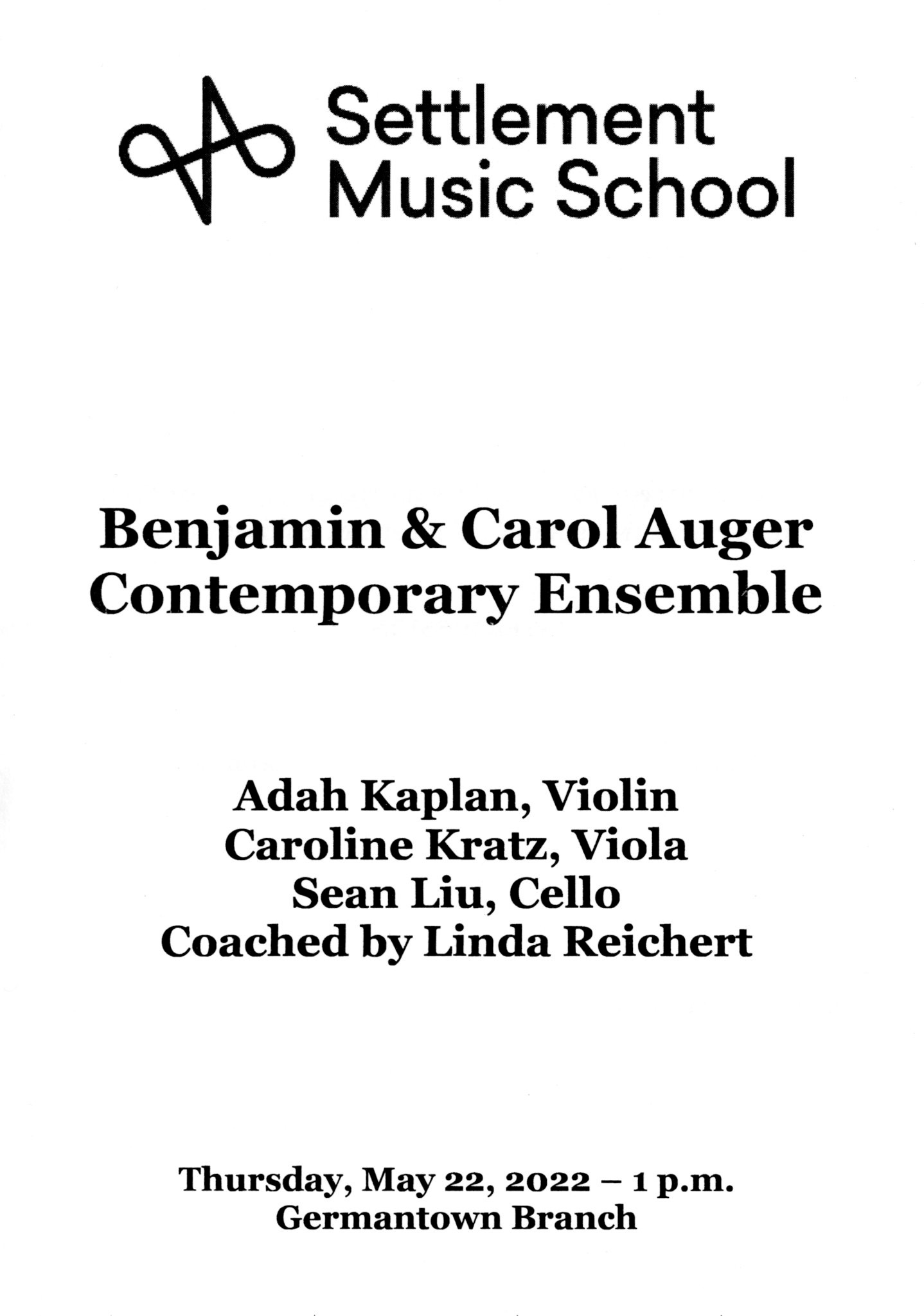
The performers (formally, the Benjamin and Carol Auger Contemporary Ensemble—one of many advanced study ensembles at Settlement) were Adah Kaplan, violin; Caroline Kratz, viola; and Sean Liu, cello. These highly accomplished high school students have been coached together on a weekly basis by Linda Reichert, a Settlement faculty member and artistic director emerita of Network for New Music. (Kratz and Liu are graduating and leaving for college, so next year new colleagues will join Kaplan.) Reichert has been coaching in the advanced ensemble program at Settlement for more than a decade, and this is the third year that she’s worked with these three players.
I first heard the trio in last year’s concert, when, due to COVID restrictions, the concert was staged out of doors, with the trio at times competing with a helicopter passing overhead. That program included works by David Ludwig, Augusta Read Thomas, Thomas Whitman, and, perhaps most memorably, cellist Sean Liu’s solo performance of the “Dialogo” movement from György Ligeti’ s Sonata for Solo Cello. Obviously, these musicians are at ease with contemporary music.
Drawing Inspiration from Ancient Art and Religion
At the trio’s concert last year, they performed a movement from The Storm (2014), by Mt. Airy composer Thomas Whitman, who was in attendance at the time. Taken as he was with their performance, Whitman wrote a new work specifically for them, Fragments from Samothrace. Whitman learned that the Winged Victory of Samothrace (now in the Louvre) is a favorite of violist Caroline Kratz, and the idea of this sculpture—its powerful, soaring lines, its destruction into fragments, and its later discovery, removal, and reassembly—all were points for Whitman’s musical imagination, including a lament in recognition its destruction and loss.
Leaving Whitman’s Greek sculpture-inspired sound world, the trio next turned to violinist Adah Kaplan’s Sh’veekeen, Sh’veeteen: Forgiven, Eradicated, a single-movement work that, as Kaplan explained, “tells the story of Kol Nidre from beginning to end (and some more).” (Read Kaplan’s detailed program here.) The work was also performed by the trio at last year’s concert, and as revised for this year, it has been tightened-up and is even more dramatically effective. The trio’s previously recorded performance (2021) of Sh’veekeen, Sh’veeteen: Forgiven, Eradicated is available on YouTube.
Music For Itself, Too
If other composers drew their inspiration from ancient art or ritual, Roberto Pace’s upon reflection had no extra-musical associations. As Pace explained, his compositional approach was to take musical material that interested him and to then work through it in various combinations and deconstructions. The result includes conversational exchanges among the instruments, as when a “silly” nattering receives a “sarcastic” response. Pace, who teaches theory and composition at Settlement Music School, among other places, duly cautioned the audience not to be distracted from the music by his words about it.
The program ended with the crowd-pleasing Lies You Can Believe In by Missy Mazzoli, a 2006 work that, in Mazzoli’s words, was “inspired as much by modern gypsy music, punk, and electronica as it is by traditional Bulgarian and Romanian folk music.” (Philadelphia audiences may know New York-based Mazzoli as a recent composer-in-residence at Opera Philadelphia.) Whatever inspired Mazzoli seemed hardly to matter. The Auger Trio navigated this episodic work, in which sections of driving motor-rhythm patterns transition into slower, more lyric passages, seamlessly.